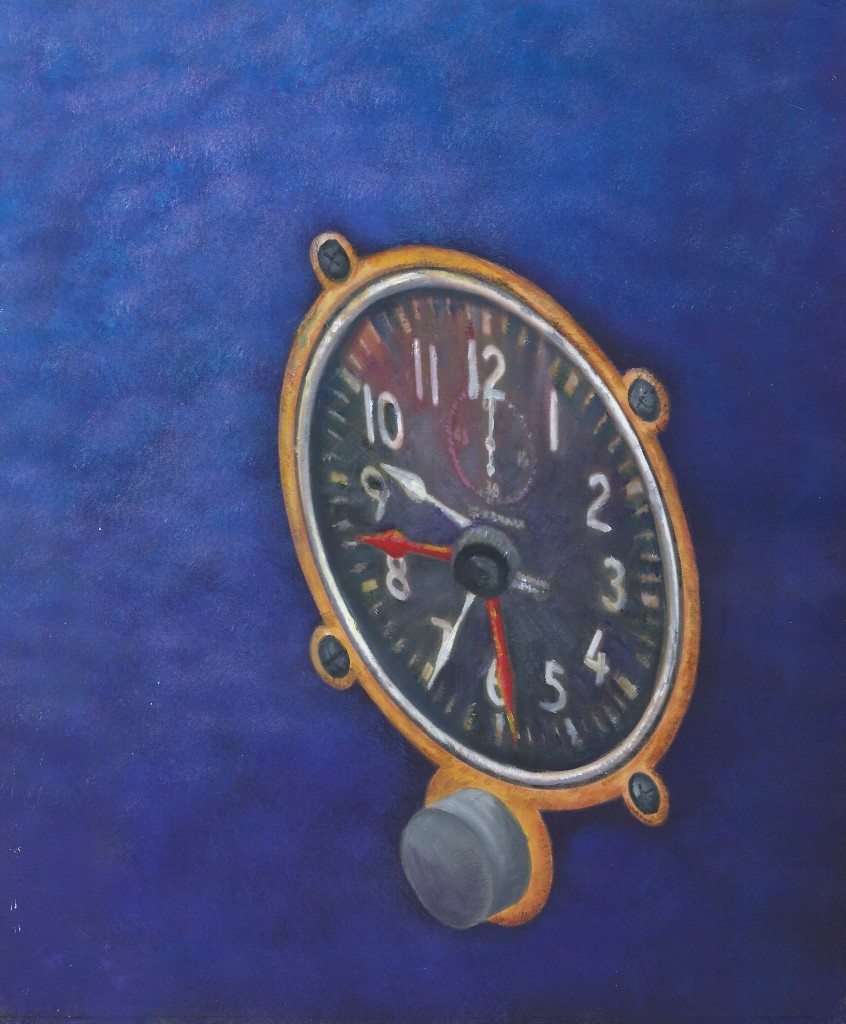
 A clocca is a clock. A clock is a bell. A bell marks a watch. From the tower each hour, the Watchman calls, “All’s well.” Wæccende, Boatman, remain awake. Ships watch changes four quarters a day. Thirty minutes, turn the double bubble upside down. Second Dog Watch finished. Eight bells and all is well. First Watch has begun. Not till the pendulum swing, did a second make the face. Chronostasis took place. Men put time in their pockets, chained to their vests. Shackled time to their wrist. Wound themselves up by the crown with their free hand. No longer Watchman standing watch. They were just men, watching a clock.
I grew up in a house full of clocks. They all chimed at different times. An 1820 Scottish longcase was the most emergent. It’s loud quarter hour chimes, overpowered the petite floor clock painted with me and our Newfoundland on its face. The Cuckoo clock in the kitchen rang in when the Glockenspiel remembered to open the door. The fancy French wall clock was wound daily, but snubbed time regularly. The brown victorian clock of no origin, nagged at time from the top of the stairs. The Wilson family clock did not work, just presided over our history. Silently guarding the mantel and the hearth. Every hour was a strange ticktocking, chiming in, all at different timing. I own one clock, and it can be found in the left hand corner of Buddy’s panel. A 1929 Pioneer Eight Day clock. It’s very rare and I spent years finding the exact one original to my plane. I am fascinated with that clock. It runs well but I never wind it. When I fly, I just move the set of red hands to mark the time I start the engine. That is the time my watch begins, and I become the Watchman who doesn’t wear a watch.
When I flew for commercial operators, flight was all about time. Time out. Time off. Time on. Time in. On schedule. Behind schedule. Ahead of schedule. The measure of a flight was measured by time. Flying the old planes is different. You get there when you get there but you get there all the same. The only presence of time in my cockpit is the red hands marking the start of the engine, and the fuel gauge telling me how long until I land. There is a timelessness in this type of flying that is a tonic for people in a time obsessed society. When I sold 30 minute flights, the only question I got about time was, “How much time do we have left?” A question asked by my flier because they didn’t want the flight to end. My flights aways ran over, at least 5 minutes. I had so many hours of Stearman time by then, I felt I could share some extra time with them. When we returned to the airport the pilots would run to get their logbook, or put the card with their flight time and my CFI signature in their wallets. Tucked away for safe keeping until they could recount it into their flight ledgers. If time is money, then flight time is a gold standard. A zeitgeber, “time-giver.” I find it fascinating when I meet a flier, the qualifier they most often define themselves by is flight time. How many flight hours they have, how long it’s been since they flew last, or how old they were when they started to fly. Timing their timelines by tenths, spent in, or away from the sky.
I am enjoying being on Sarah time. Living on the circadian clock of the islands and the lake. There are no working clocks in my cottage this summer, the only sign of time are the bells. Westminster chimes; singing the song of St. Mary the Great and the Pugilist’s Tower across the lake. I found myself looking forward to hearing the bells. Waiting for them. Then noticing their absence and wondering when they would ring again? The bells echoing across the water were beautiful, but they were inconsistent. Some half-hours they didn’t ring at all. Some times they played a song. When they chimed the time, they began on the 9’s instead of the 0’s. I began timing the bells to the atomic clock on my computer and trying to find a pattern. Was I in an acoustic shadow? I like playing connect the dots. Time to find the source. I followed the sound of the carillon to the Community Church in town. A pretty little church on a hill above the lake. I didn’t see a bell tower. I asked the Secretary about the church bells. She didn’t know when they set the bells, or why they played what they did. She did ask me, “You do know they are electronic?” No I did not, but I found it very ironic. I had become a Kettle and Nob. A Kettle is Cockney slang for a watch, its origin coming from the phrase, “A watched kettle never boils.” The bells chimed in their own time, on their own clock. But they did chime each day, all the same, and it was a joyful noise. Maybe the seconds they’re early, or late, is extra time we can share on the lake.
Every pilot I’ve ever met, certificated or not, looks up each time a plane fly’s by. The atomic clock stops for them when they hear the sound of an airplane engine. They stop what they’re doing and watch that plane fly. Watchman still, standing watch. The sound of a plane, like a bell. Reminding, Wæccende. I am here. All’s well.
Happy Fathers Day to all the Watchman. Dad’s standing watch, guarding the mantel and the hearth.

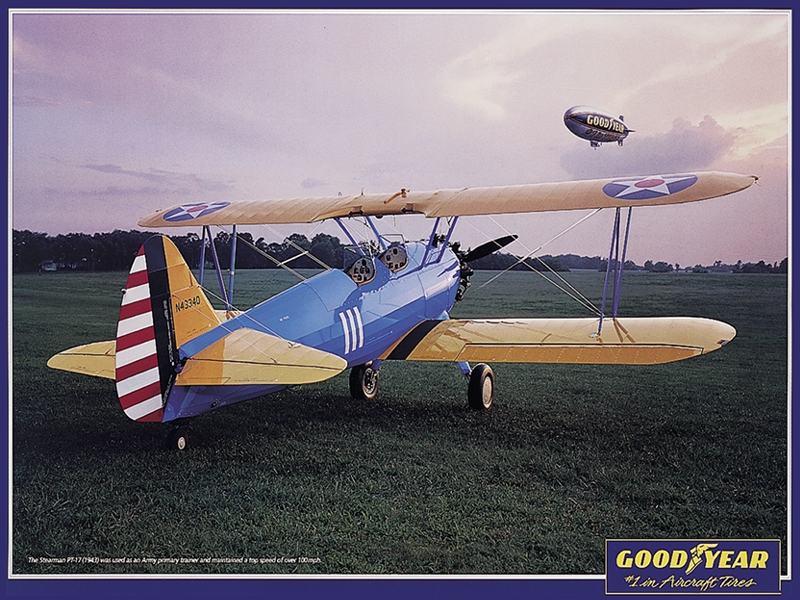 In the years counting up to the time you start growing young again, it is easy to forget the worst thing that can happen to anyone is losing their first best friend. People worry about losing so many things, because people think they get to own everything, but that’s the best part of a friend. Friends choose you and you choose them.
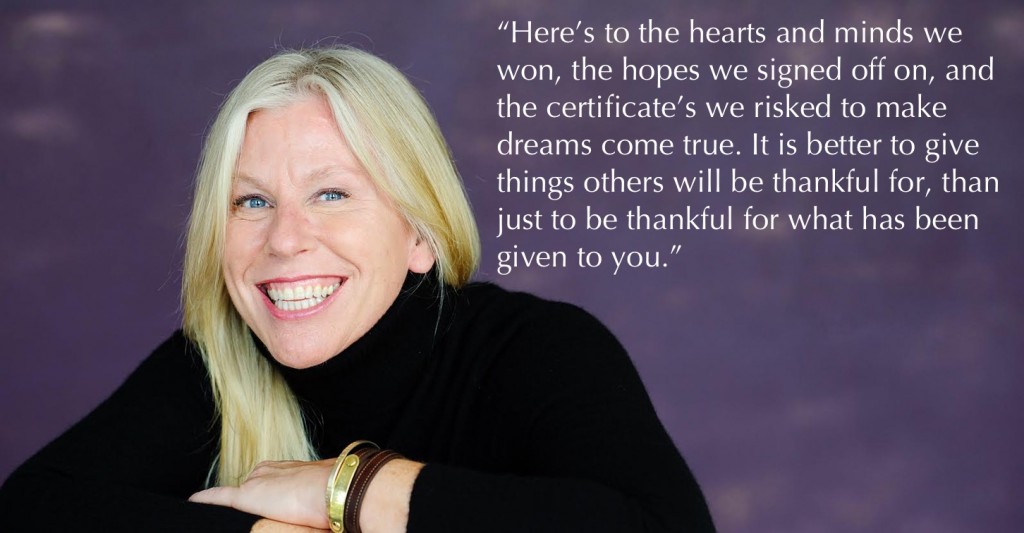 Twelve months gathered around the Thanksgiving table, each one was asked to say why they were grateful and what they brought to share. Sitting by their friends, in cliques of seasons, winter began. December fell frozen in thought, “I am grateful to have been a Lifeguard Pilot. I share all the lives I saved.” I raced through eight-day weeks and twenty-five hour nights, declaring priority with people coding in my hull, to bring broken bodies back to safety. January rang in resolutely, “I am grateful to have been a Co-pilot. I share all the assistance I gave.” Your right seat companion, your second set of eyes, I thought thoughts before you said them. Privileged to be your partner in flight. February smiled seductively and blew a kiss across the table, tracing a heart in its breath. “I am grateful I have been a passenger. I share all the admiration I gave.” A sleepy head on your shoulder, I looked up at you starry-eyed. I couldn’t imagine the courage it took to be a pilot. You made me feel so safe I lost all fear of flying, flying with you.
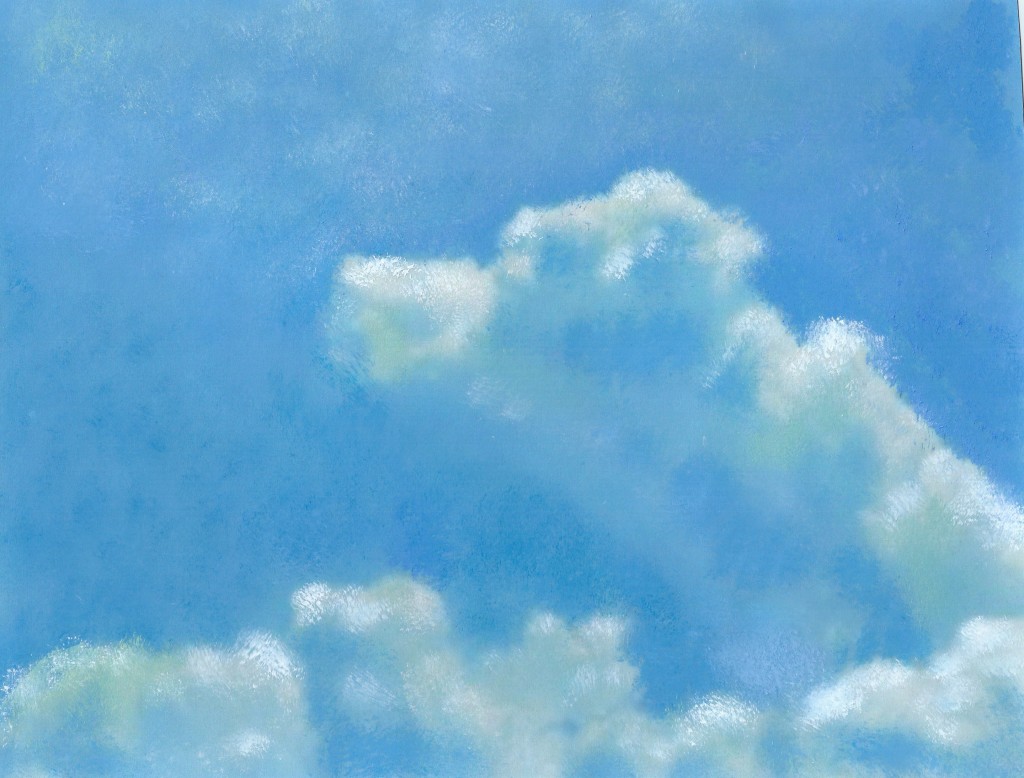 The sun’s been up all day waiting for you. Climb up here and sit on my lap, there’s something I want to tell you. Let’s buckle you up, under my belt. Now put your hands on the stick and fly along with me. See that cloud up there? The fluffy one with the big nose, that’s puffing in and out. It’s smelling you. It thinks you smell like peanut butter and baby shampoo. Your turn, pick a cloud and breathe in. What do you smell? Don’t be embarrassed, no one can hear you up here. “Rain?” Good. What else? Use your imagination, breathe in again and tell me what you smell? “Puppy breathe.” Excellent! Guess what I smell? Chalk, let me tell you why.
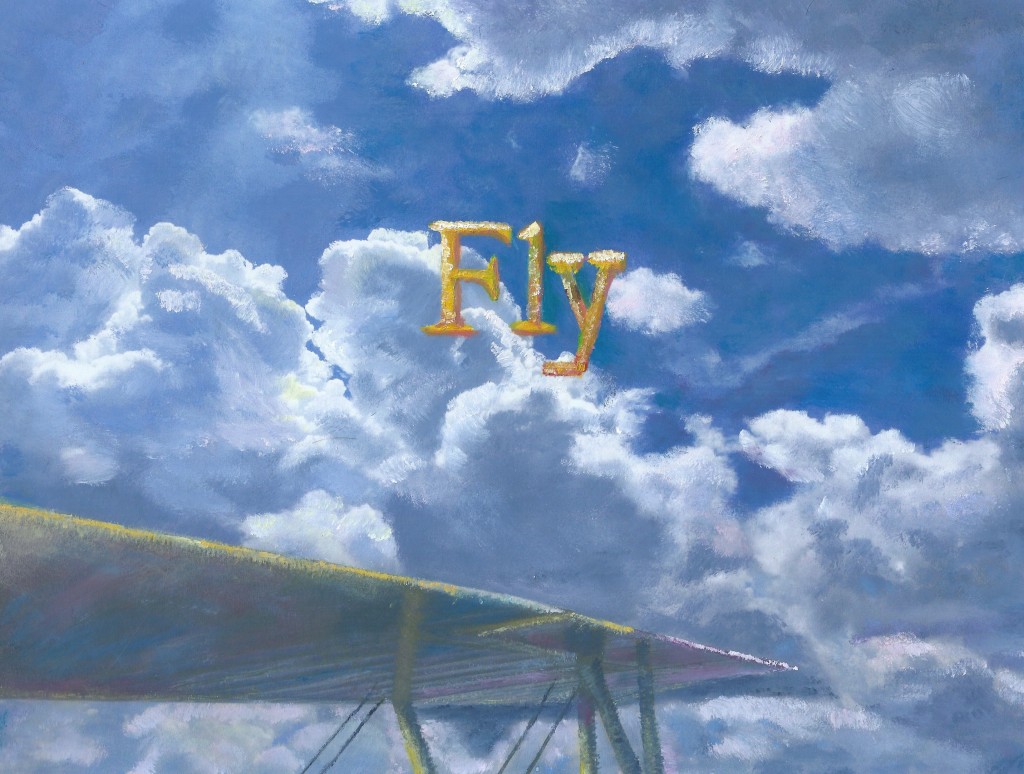 If you saved every word you said in the air, what would your story be? Starting as a student pilot, childish words skip out of your mouth and trip over your microphone. Stubbing your mind just trying to say – who you are, where you are, and what you want to do. Your flight instructor, always correcting and editing your transmissions, has sent you on a solo flight. Tongue twisted, finger shaking, afraid to push to talk – you wait. Blushing and rushing through each phrase in your memory bank, you race to catch up with your words before they runaway with your thoughts. Finally you transmit, and a novel pours out of you. “Silence,” A mysterious voice interrupts. “The airwaves are full of pilots telling their stories. We only have slots for four words per pilot, per lifetime. Choose carefully the words you choose to say.” Picking up your courage from the piles of emotions scattered around your head. Sifting through your thoughts, you go digging for the perfect word. A word reaches up, like an outstretched hand, lifting your tongue up off its knees to speak. A word so soft, it whispered right by your mind and out the other side, before you noticed it had been there all the time. You open your mouth, press the switch, close your eyes, and leap. “Fly.” And so the first word of a pilot’s story is written in the sky.
 There is a door in my front seat, a Gibb door, streamlined and finely crafted. A secret passage. If closed, it’s hidden along the sleek physique of my plane. I leave it open, like an open invitation. Nothing is as welcoming as an open-cockpit biplane with an open door. A leather strapped hinged hug swings out to greet you. A crooked smile spreads across the face of the fuselage of my plane. Grinning wing to wing. Welcome back. Welcome home. Climb in, buckle up. Take my hand, take the stick. How long has it been? I can’t wait to show you around the sky. Let’s fly over there, that’s the view I’ve been waiting to share with you. Hang your head over the side. Sit awhile and visit the wind with me. Look how gently the wind runs its fingers across the lake. See it combing through the corn rows, untangling the knots in the wheat? The branches of the trees in the orchard are waving. The wood smoke rising above the meadow is signaling. Watch the wind write a timeline of where it’s been. Still waters next to the shore of the lake, telling tailwheel’s tales of where to safely land.
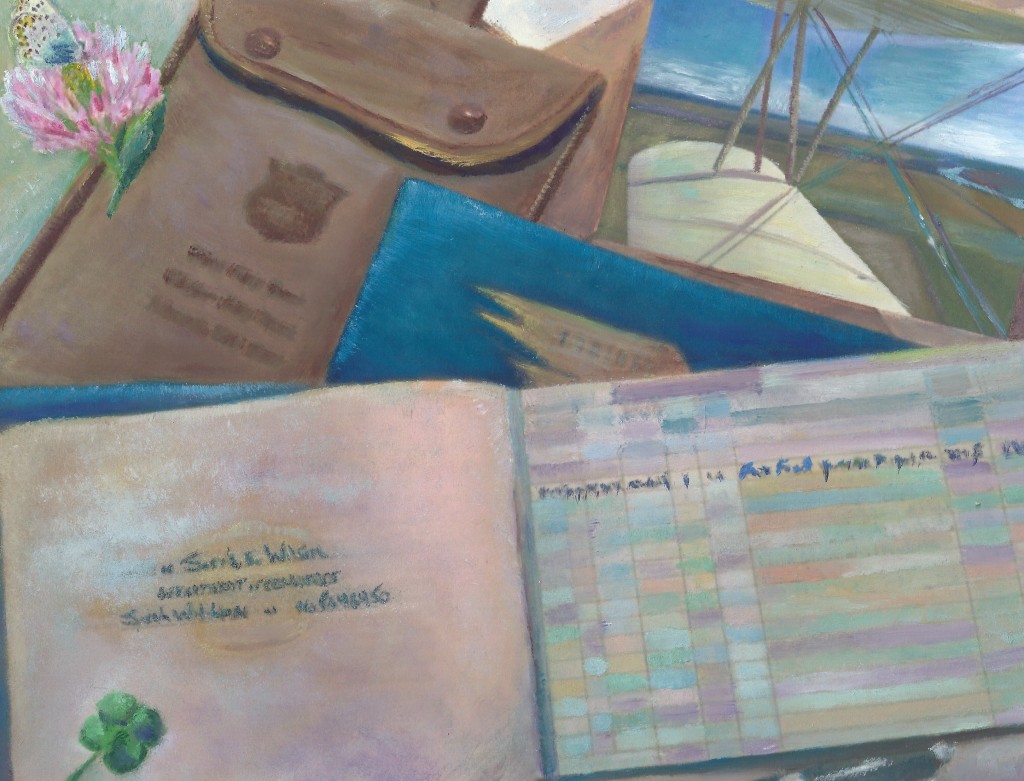 A logbook lays in a box on my hangar floor in the company of things I keep to remind me of where I’ve been. Leather bound lines sit silently in past tense, present yet. Not updated for years, this linear ledger is left unfinished. A cypher waiting to be broken, you might wonder why it stopped when it did? I know the key. A foreigner, I arrived in the New Land of old planes and my world changed. Like an immigrant landing on Ellis Island, I was given the chance to begin my history again. Set free to explore in my Stearman that first summer, I saw undiscovered beauty in the air like second sight. Learning to fly my open-cockpit biplane allowed me to have another first flight. With great freedom comes great responsibility. I wanted to record what I had found for people who were not free to chase their dreams. When I went to write, confining bars confronted me. The logbook I had kept for over a decade looked like a leather bound cage. How could I fit on a single black line what it felt like to land my Stearman in a clover covered field of butterflies? Where was the space big enough to log a life-altering experience? Never one to settle for status quo, I question why everything is what it is.
 Delayed at Monocracy Junction under the eclipse of the blood moon, we wait. Guests in the General’s tent at AOPA, my plane is offered shelter indefinently. Surrendering to winds and weather, a losing battle I choose never to fight. I am at liberty to roam the battlefields of Maryland and Virginia, while a private battle wages inside me. Silenty. My pilots’ wars are covert. Forces of fear and impatience clash in the thickets of me. A victory I choose to win over myself, I pull out my field kit of crayons and pastels and color the world want I want to see. I fly behind a supply train of expectations to deliver my plane safely. I rise each morning with the first light of anticipation, and fall each night in the belief tomorrow is the day we will fly. Like a Fabian Strategy, the whether of weather wages a war of attrition on me. Held at the station, holding on hope, I call in the cavalry from Calvary for reinforcement. I repeat my oath. “I never have to be anywhere. I’m not that important, but my plane is.” My plane is much greater than me.